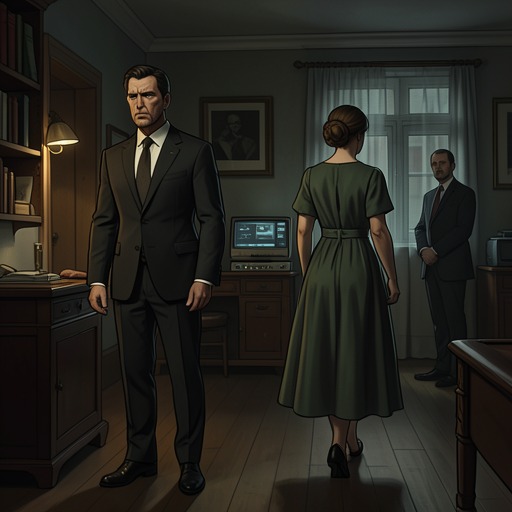
Eve Copeland and Jared Copeland's father-daughter relationship
The RadleysEve Copeland and Jared Copeland’s father-daughter relationship is marked by a painful contrast: Eve still recognizes the loving father who once cared for her, but now sees a grieving, financially precarious man whose efforts to protect her can deepen her embarrassment and frustration. Their bond is neither simply broken nor easily repaired. It appears in a family memory of calamine lotion, in arguments over her freedom and their housing, and in Eve’s brief recognition that her father’s sadness is also a form of shared loss.
Family Bond and the Changed Father
Eve’s view of Jared is inseparable from the contrast between the father she remembers and the one who comes to meet her on a Friday night. When he crosses a field toward her, she initially sees a thin stranger; hearing him call her name makes her realize that he is her father. His appearance embarrasses her in front of Toby Felt: he wears an ill-washed Manchester United shirt and has unkempt hair. She feels the distance between this man and the father she knew when her mother was still present, and recognizes that even she can scarcely see the earlier version of him now.
Jared’s attention to Eve carries a different kind of memory. He notices the skin revealed by her top and recalls caring for her after she fell among nettles on a family holiday, when he applied calamine lotion. The recollection is concrete and tender, rooted in the ordinary work of a parent looking after a child. It also stands against the present scene: Eve is seventeen, among friends, and acutely conscious of how her father’s arrival affects the way they see her.
Freedom, Safety, and Money
Eve explicitly invokes her age and the fact that it is Friday night when she argues that she should be allowed some freedom. Jared, by contrast, approaches the situation through danger and the family’s immediate vulnerability. He tries to draw her attention back to their past, hoping that memory will anchor her and help keep her safe. His appeal shows care, but it also exposes a gap between the two: he reaches for shared history at the moment she wants him to recognize her present independence.
That tension is sharpened by money. Eve explains that Toby is Mark Felt’s son and says Toby will speak to his father about the rent. She has told Toby that she now has a job and that they will be able to pay double the following month; she believes this arrangement will make things all right. Jared rejects the idea that she should have to put herself in a compromising position to secure favors from their landlord. His refusal expresses a clear protective boundary, but it also clashes with Eve’s sense that the family has few workable choices.
Eve answers by imagining what happens if Jared does not recover his focus: they could lose their home, move again, end up in a cheap motel or a bus shelter, and struggle to obtain food. Her anger is therefore not just a demand for permission to go out. It is an argument about the material pressures shaping her life and about the burden she feels when her father cannot manage them. The scene gives her fear and resentment a practical basis: rent, housing, work, and food are all part of the dispute.
Grief and Protection
For a moment, Eve’s perception of Jared changes. She no longer sees only the father who has embarrassed her in front of her friends. She sees someone who has suffered alongside her. Her gaze settles on his hands on the steering wheel and on the wedding ring he will never remove. The ring makes his grief visible without resolving it; it links their present hardship to the family loss that has altered both of their lives.
Jared’s later restriction of Eve shows the continuing force of his protective role. He apologizes but tells her that she must stay in for the weekend, while still wearing the coat he had on when he returned from elsewhere. His manner leaves little room for compromise. The decision reinforces the same conflict seen on the field: Jared acts to impose a boundary, while Eve’s earlier insistence on freedom indicates how constraining such protection can feel to her. The available scenes do not show the argument being settled; instead, they establish a recurring strain between care and control.
A Bond Under Pressure
The pressure on their relationship is also legible to people outside the family. Toby’s harsh division of people into the strong and the weak places Eve’s father among those he considers weak. This is Toby’s judgment, not an objective account of Jared, but it reflects how the family’s vulnerability can become visible to others and how Eve’s social world may expose her to contempt as well as embarrassment.
Later, Jared is present in a discussion with Helen Radley about what converting Eve would mean. Helen tells him that giving Eve vampire blood would make her a vampire and that Eve could develop especially strong feelings toward the person whose blood was used. Jared already knows this consequence. The exchange places him within a moment of grave change in his daughter’s life, though it does not, by itself, establish what he wants or decides. It does show that their relationship is bound up with questions of care, danger, and what family responsibility can mean when Eve’s condition is changing.
The relationship’s defining movement is not a neat reconciliation but a repeated alternation between distance and recognition. Eve resents Jared’s appearance and restrictions, yet understands that his decline is tied to suffering she shares. Jared remembers caring for her as a child and tries to keep her safe, but his protective actions meet a daughter who must also confront the family’s financial reality. The memories, the wedding ring, and their arguments keep affection present without making it a cure for grief or hardship.